

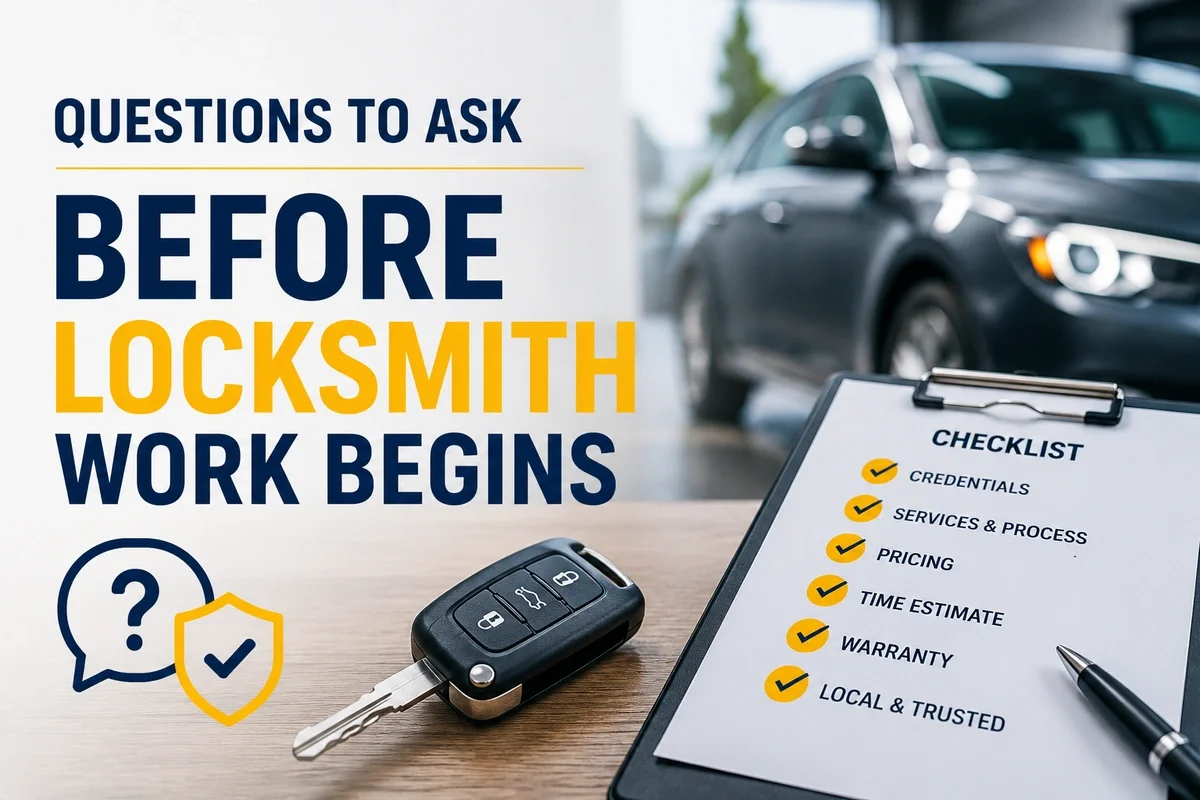
Before locksmith work begins, make sure you understand what the locksmith found, what service is being recommended, why that service is appropriate, what work you are authorizing, whether hardware or parts will change, how existing keys or credentials will be affected, and what you should test after the work is complete.
You do not need technical locksmith knowledge to have this conversation.
The objective is simply to understand the scope before authorizing the work.
Summary
- Ask what the locksmith found during the assessment.
- Confirm the specific service being recommended.
- Ask why that service matches the problem.
- Understand exactly what you are authorizing.
- Clarify whether existing hardware will remain or change.
- Ask whether existing keys or credentials will still work.
- For automotive or electronic service, identify which functions are included.
- If another problem is discovered, clarify whether it represents additional work.
- Know what you should test before the service visit ends.
- Keep applicable documentation describing the completed work.
Why Ask Questions Before Authorizing Locksmith Work?
Locksmith terminology can describe very different services.
For example:
Unlocking restores authorized access.
Rekeying changes which mechanical key operates compatible lock hardware.
Repair addresses a hardware problem.
Replacement changes hardware.
Key cutting creates the mechanical form of a key.
Programming can address electronic vehicle-key functionality for supported systems.
Those services should not be treated as interchangeable.
"Before locksmith work begins, the most important thing for a customer to understand is the scope. What did the technician find, what work is being recommended, and what will be different when that work is complete? Clear answers to those questions create a much better service conversation." - KeyMe Locksmiths
Need a Locksmith? We're here to help
Connect with a trusted local locksmith for fast, professional assistance when you need it most.
Question 1: What Did You Find?
Start with the assessment.
Ask the locksmith to explain what is preventing normal operation.
Depending on the service, the finding might involve:
- Missing or inaccessible key
- Broken key
- Lock cylinder
- Latch
- Deadbolt
- Door alignment
- Damaged hardware
- Electronic lock
- Vehicle key
- Another component
This gives the rest of the service discussion a clear starting point.
ALOA's consumer guidance demonstrates why diagnosis matters. Difficult lock operation can involve door alignment, weather, worn keys, lock wear, or other hardware conditions.
Understanding the finding helps you understand the recommendation.
Question 2: What Service Are You Recommending?
Ask for the specific service.
That might include:
- Unlocking
- Broken key extraction
- Lock repair
- Rekeying
- Lock replacement
- Lock installation
- Key cutting
- Car key programming
If you do not recognize a term, ask what it means before approving the work.
For additional terminology, see Locksmith Terms Explained.
Question 3: Why Is That Service Appropriate?
Knowing the service name is only part of the conversation.
Ask why that service matches the condition the locksmith found.
For example:
Why Repair Instead of Rekey?
Rekeying changes mechanical key access. It does not inherently correct a damaged latch, misaligned opening, or other mechanical failure.
Why Replace Instead of Repair?
Ask what condition of the existing hardware led to the replacement recommendation.
Why Programming in Addition to Cutting?
Modern vehicle keys can involve electronic authorization as well as mechanical key geometry.
NHTSA explains that some immobilizer systems incorporate computer chips in ignition keys to help prevent unauthorized vehicle activation.
Understanding the reason for each service helps define what you are approving.
Question 4: What Exactly Am I Authorizing?
This should be explicit.
Compare:
General:
"Fix the lock."
with:
Specific:
"Repair the identified lock hardware."
Or:
General:
"Make the car key work."
with:
Specific:
"Cut and program the supported replacement vehicle key."
Specific authorization creates a clearer boundary around the agreed work.
If more work is identified later, it can then be discussed separately.
Question 5: Will the Existing Hardware Remain?
Ask whether the service will retain or change the existing lock hardware.
Depending on the recommendation:
- Rekeying may retain compatible hardware while changing mechanical key access.
- Repair may retain the existing lock while servicing a component.
- Replacement changes the applicable hardware.
- Installation may introduce new hardware.
For a deeper comparison, see Rekeying vs. Replacing Locks.
Question 6: Are New Parts or Hardware Involved?
If the service includes a component or hardware change, ask what is being changed.
Examples can include:
- Cylinder
- Latch
- Deadbolt
- Complete lock
- Other applicable hardware
Residential locksets, latches, and deadbolts are subject to defined hardware-performance standards. BHMA's current residential standards include A156.39-2025 for locksets and latches and A156.40-2025 for residential deadbolts.
Understanding what will remain and what will change makes the service scope more concrete.
Question 7: Will My Existing Keys Still Work?
This question is especially important when the service changes a cylinder, keying arrangement, or complete lock.
Ask which existing keys will continue to operate the opening after the work.
This can matter for:
- Homeowners
- Household members
- Landlords
- Property managers
- Maintenance personnel
- Businesses
- Master-keyed properties
Do not assume the answer.
Ask specifically.
Question 8: Will This Change Anyone Else's Authorized Access?
This goes beyond whether your own key works.
For a residential property, ask whether other household keys remain valid.
For a rental or multifamily property, determine whether intended management or maintenance access is affected.
For an electronic system, clarify whether existing:
- Codes
- Fobs
- Cards
- Mobile credentials
remain active where applicable.
For a vehicle, determine whether other authorized keys continue to function if the service involves programming.
The answer depends on the system and the authorized service.
Find a KeyMe Kiosk Near You
Need a spare key fast? Find a KeyMe kiosk near you to copy many house, office, and eligible car keys in just minutes.
Question 9: What Functions Should Work When the Service Is Complete?
"Working" should have a practical meaning.
Residential Lock
Depending on the service, that may mean checking:
- Key operation
- Locking
- Unlocking
- Latch operation
- Deadbolt operation
- Door operation
Smart or Electronic Lock
Applicable functions might include:
- Mechanical operation
- Keypad
- Authorized credential
- Backup key
- Other included electronic functions
Vehicle Key
Ask which functions are included in the service.
Depending on the vehicle and key, these can involve:
- Mechanical door access
- Ignition
- Vehicle start
- Remote lock
- Remote unlock
- Push-to-start
NHTSA's description of immobilizer technology helps explain why mechanical and electronic vehicle-key functions should not automatically be treated as the same thing.
Question 10: What Happens If You Discover a Different Problem?
Sometimes the on-site assessment changes after work begins or another condition becomes visible.
Ask how additional findings will be handled before additional work proceeds.
The important distinction is:
What have I already authorized?
versus
What additional work is now being recommended?
If the initial service itself changed after the technician's on-site assessment, see Why Locksmith Estimates Can Change After Arrival.
That article explains how hardware condition, door problems, electronic systems, vehicle-key technology, and other findings can change the understood scope.
Question 11: Is the Additional Work Separate From the Original Service?
Suppose a locksmith is called for a lockout and later identifies a damaged lock.
Or a broken key is extracted and the cylinder is also found to be malfunctioning.
Ask whether the additional recommendation is:
- Necessary to complete the already authorized service
- A separate repair
- A separate replacement
- Another service that can be considered independently
This prevents two different service needs from being treated as one vague task.
Question 12: What Should I Know Before Rekeying?
If rekeying is recommended, ask:
- Which locks are included?
- Which keys will stop working?
- Which new keys will operate the locks?
- Is the existing hardware otherwise remaining?
- Is the lock part of a master-key system?
Rekeying primarily addresses mechanical key access.
If the underlying hardware is malfunctioning, ask whether repair also needs to be considered.
Question 13: What Should I Know Before Lock Replacement?
If lock replacement is recommended, ask:
- Which hardware is being replaced?
- Why is replacement recommended?
- What hardware will remain?
- What keys will operate the new lock?
- Will other related locks be affected?
If the purpose is to change access rather than address hardware condition, ask whether rekeying is applicable to the existing hardware.
Question 14: What Should I Know Before Vehicle Key Service?
For car key replacement, clarify the specific functions included.
Ask whether the service involves:
- Mechanical cutting
- Electronic programming
- Remote functions
- Vehicle start
- Other applicable functions
NHTSA notes that immobilizing anti-theft systems can incorporate computer chips in keys, which is one reason vehicle-key service can involve more than physical duplication.
If other authorized vehicle keys exist, ask whether the planned service affects them.
Question 15: What Should I Test Before the Visit Ends?
Once the authorized work is complete, test the functions included in the service when appropriate.
After Residential Lock Work
Check applicable:
- Key insertion
- Key removal
- Locking
- Unlocking
- Deadbolt
- Latch
- Door operation
If operation changes significantly depending on whether the door is open or closed, mention that observation. ALOA notes that door alignment can affect lock and latch operation.
After Electronic Lock Work
Test the applicable authorized credentials and mechanical functions included in the service.
After Vehicle Key Work
Test the functions included in the authorized service, which may include mechanical access, start, remote buttons, or proximity functionality depending on the key and vehicle.
Question 16: What Documentation Should I Keep?
Keep applicable service documentation for your records.
Depending on the service, that can include:
- Service description
- Work authorization
- Receipt or confirmation
- Relevant hardware information
- Key or programming information provided as part of the service
- Property work-order records
Property managers and businesses may also need to update internal access or maintenance records after applicable locksmith work.
Best Way to Prepare Before Locksmith Work Begins
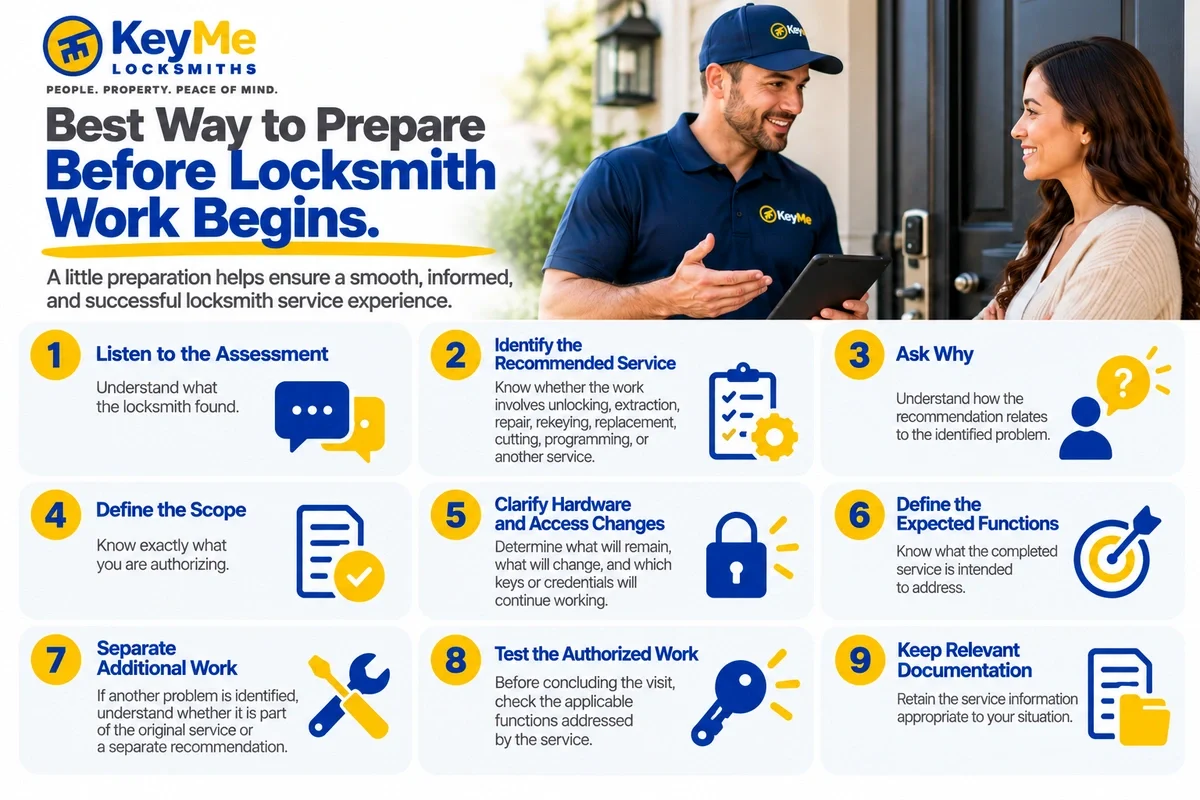
1. Listen to the Assessment
Understand what the locksmith found.
2. Identify the Recommended Service
Know whether the work involves unlocking, extraction, repair, rekeying, replacement, cutting, programming, or another service.
3. Ask Why
Understand how the recommendation relates to the identified problem.
4. Define the Scope
Know exactly what you are authorizing.
5. Clarify Hardware and Access Changes
Determine what will remain, what will change, and which keys or credentials will continue working.
6. Define the Expected Functions
Know what the completed service is intended to address.
7. Separate Additional Work
If another problem is identified, understand whether it is part of the original service or a separate recommendation.
8. Test the Authorized Work
Before concluding the visit, check the applicable functions addressed by the service.
9. Keep Relevant Documentation
Retain the service information appropriate to your situation.
Why Choose KeyMe Locksmiths?
KeyMe provides access to locksmith services for supported residential, commercial, emergency, and automotive needs.
Relevant services include:
- Emergency locksmith service
- Residential locksmith service
- Commercial locksmith service
- Lock repair
- Rekeying
- Lock replacement
- Broken key extraction
- Car locksmith service
- Car key programming
Before work begins, understand the recommended service and what it is intended to address.
Copy Your Key from Anywhere - Right from Your Phone
Skip the kiosk and copy your key from home. Upload a clear photo of an eligible house or car key, and KeyMe will create a precise duplicate and mail it directly to your door.
Understand the Work Before You Authorize It
You do not need to diagnose the lock yourself.
You do not need to know every locksmith term.
You do need to understand the service conversation:
What did the locksmith find?
What work is being recommended?
Why?
What am I authorizing?
What hardware will change?
Will existing keys or credentials still work?
What functions should work when the service is complete?
What happens if another problem is discovered?
Those questions keep the focus on a clearly defined scope of work.
If the service identified on-site is different from what you expected when requesting help, see Why Locksmith Estimates Can Change After Arrival.
References
- Associated Locksmiths of America (ALOA). Common Lock Issues. Consumer guidance explaining how lock symptoms can involve door alignment, weather, worn keys, lock wear, and other conditions.
https://www.aloa.org/consumers/commonlockissues - Builders Hardware Manufacturers Association (BHMA). ANSI/BHMA A156.39-2025 Residential Locksets and Latches. Current performance standard for residential locksets and latches.
https://buildershardware.com/ANSI-BHMA-Standards/Hardware-Highlights/A15639-2025-Residential-Locksets-and-Latches - Builders Hardware Manufacturers Association (BHMA). Hardware Highlights. Current standards library including residential deadbolts, electrified locking devices, commercial locks, and other builders hardware.
https://buildershardware.com/ANSI-BHMA-Standards/Hardware-Highlights - National Highway Traffic Safety Administration (NHTSA). Vehicle Theft Prevention. Current information about vehicle anti-theft technology, including immobilizing systems that can incorporate computer chips in ignition keys.
https://www.nhtsa.gov/vehicle-safety/vehicle-theft-prevention