
America’s Most Common Key Fob Problems: What KeyMe Service Data Reveals About Modern Vehicle Access Technology
The Biggest Threat to Modern Car Keys Isn’t Wear and Tear. It’s Increasing Complexity.
For decades, vehicle key problems were largely mechanical.
A worn key blade could be copied. A damaged key could be replaced. Most failures were visible and relatively straightforward to diagnose.
That is no longer the case.
Analysis of proprietary KeyMe automotive key service and troubleshooting data reveals that the most common key-fob failures in America are increasingly electronic, software-driven, and security-related. Programming failures represent the single largest service issue in the dataset, significantly outpacing many traditional hardware problems. Other leading categories include vehicle recognition failures, lock and unlock communication issues, button malfunctions, and ignition-related authentication problems.
The findings highlight a fundamental shift occurring across the automotive industry.
Modern vehicle keys are no longer simply keys.
They are encrypted credentials that must communicate with increasingly sophisticated vehicle security systems.
As a result, many of the most common problems drivers experience today have less to do with damaged hardware and more to do with the growing complexity of automotive access technology.
This report analyzes nationwide troubleshooting patterns observed through KeyMe’s vehicle key programming, duplication, and support operations to identify the key-fob problems drivers encounter most often—and what those problems reveal about the future of vehicle access.
Key Findings
Programming Failures Are the Largest Service Category
Programming-related issues generate more troubleshooting activity than any other individual error category in the dataset.
Vehicle Authentication Has Become a Common Failure Point
Many reported issues involve vehicles failing to recognize, authenticate, or properly communicate with otherwise functional keys.
Key Fob Problems Are Increasingly Electronic
Button failures, signal issues, lock/unlock communication problems, and ignition recognition concerns appear throughout service records.
Certain Vehicle Platforms Generate Disproportionate Troubleshooting Volume
Honda, Ford, Toyota, Chevrolet, and several other high-volume manufacturers account for significant portions of automotive key service activity.
Not Every Modern Key Can Be Easily Duplicated
Growing security protections have increased the complexity of key programming and duplication across many vehicle platforms.
Programming Has Become the Defining Challenge of Modern Vehicle Access
The most important finding in the data is not a hardware failure.
It is a software and security challenge.
Programming-related issues represent the largest troubleshooting category observed in KeyMe automotive key service records.
That finding reflects a broader transformation occurring throughout the automotive industry.
Vehicle security systems increasingly rely on encrypted communication between the vehicle and the key. As a result, a properly cut key can still fail if the vehicle does not recognize the electronic credential embedded inside it.
From a consumer perspective, the symptom appears simple:
“The key won’t work.”
From a vehicle-security perspective, the challenge is significantly more complex.
Programming problems may appear as:
- A key that fits the ignition but does not start the vehicle
- A remote that unlocks doors but fails ignition authentication
- A fob that programs partially but not completely
- A vehicle that rejects a newly created key
- A key that works mechanically but fails electronically
This is why modern car-key service increasingly requires technical knowledge beyond cutting a blade. The key must also be accepted by the vehicle’s onboard security system.
“The customer often sees one problem: the key does not work,” says a KeyMe automotive key specialist. “Operationally, that can mean several different things. The cut may be correct, but the vehicle may reject the credential, the remote functions may not pair, or the immobilizer may not authenticate the key.”
Dead Batteries Still Cause Everyday Failure
Although programming failures dominate service data, dead or weakening batteries remain one of the most common everyday key-fob issues consumers experience.
A weak fob battery can create symptoms that resemble larger failures:
- Reduced operating range
- Intermittent lock and unlock response
- Delayed button performance
- Passive entry failures
- Push-button start recognition issues
- “Key not detected” warnings
- One reason battery problems create confusion is that they often develop gradually.
The fob may still work sometimes.
It may unlock the car from a short distance but fail from farther away. It may start the vehicle one day and trigger a warning the next. That inconsistency can make drivers assume the entire key is failing.
From a service perspective, battery troubleshooting is often the first step because it is one of the simplest variables to eliminate.
But if symptoms continue after a fresh battery, the issue may involve the fob’s electronics, the vehicle receiver, or the programming relationship between the key and vehicle.
Signal and Communication Issues Are Increasingly Common
Modern key fobs depend on radio-frequency communication between the fob and the vehicle.
That communication can fail even when the key itself is not physically damaged.
Drivers may experience:
- Lock and unlock functions that only work near the vehicle
- Passive entry that fails intermittently
- Push-button start systems that do not detect the fob
- Remote functions that work in one location but not another
Signal issues are especially challenging because they can appear inconsistent.
A key may work reliably at home but fail in a parking garage, apartment complex, or commercial area with heavy wireless interference.
Signal problems may be caused by:
- Weak fob batteries
- Radio-frequency interference
- Damaged fob antennas
- Vehicle receiver issues
- Environmental interference
- Internal fob damage
The KeyMe service data includes lock and unlock communication failures as a recurring issue category, reinforcing that not all key-fob problems are tied to cutting or physical duplication.
Button Failures and Wear Still Matter
Modern key fobs are electronic devices, but they are also everyday carry items.
They are dropped, squeezed, exposed to moisture, stored in pockets, tossed into bags, and used thousands of times over their lifespan.
Wear-related problems often include:
- Buttons that no longer respond
- Buttons that require extra pressure
- Cracked shells
- Loose battery contacts
- Worn internal switches
- Damaged circuit boards
- Water exposure
- Broken emergency key inserts
KeyMe troubleshooting data includes customer-reported button failures and lock/unlock problems, which are often associated with aging fobs, physical damage, or internal wear.
These issues are different from programming problems because the vehicle may still recognize the key, but the fob hardware no longer performs reliably.
“A key fob can fail in layers,” says a KeyMe vehicle programming expert. “The blade may still work, the transponder may still be recognized, but the buttons or remote functions may stop responding. That is why diagnosing modern keys requires looking at mechanical, electronic, and programming behavior together.”
Ignition Recognition Problems Reveal the Gap Between Cutting and Programming
One of the most important distinctions in modern automotive key service is the difference between a key that fits and a key that starts.
A key can be cut correctly and still fail ignition authentication.
This happens when the mechanical profile is correct but the electronic credential is missing, incorrect, unsupported, or not accepted by the vehicle.
In customer terms, this may sound like:
- “The key fits but won’t start the car.”
- “The fob unlocks the doors but the car will not recognize it.”
- “The ignition turns, but the engine will not start.”
- “The vehicle says the key is not detected.”
These failures are especially common in transponder and smart-key systems because the vehicle is not simply checking the physical key shape. It is also verifying whether the key has permission to start the vehicle.
That is why programming failures and ignition-related issues are central to understanding modern key-fob problems.
The Rise of Protected Keys
One of the clearest trends emerging from automotive access technology is the growth of highly protected key systems.
Historically, most vehicle keys could be duplicated if the proper equipment and expertise were available.
Today, some vehicle manufacturers have introduced additional layers of security that restrict how credentials are generated, authenticated, and programmed.
As these systems become more sophisticated, certain keys may require:
- Manufacturer authorization
- Secure gateway access
- Online credential verification
- Vehicle-specific authentication procedures
- Proprietary programming workflows
The purpose is straightforward: reduce theft and unauthorized programming.
The result is a growing divide between keys that can be readily duplicated and keys that operate within heavily protected security ecosystems.
“One of the biggest misconceptions consumers have is that every key can be copied the same way,” says a KeyMe automotive key specialist. “In reality, some modern keys function more like security credentials than traditional keys. The technology protecting the vehicle also increases the complexity of duplication.”
This is why some keys are simply too complicated to copy through standard workflows. The issue is not always equipment or skill. In some cases, the vehicle’s security architecture is intentionally designed to limit duplication paths.
Why Some Vehicles Generate More Troubleshooting Volume
The dataset also shows that troubleshooting and refund patterns are not evenly distributed across every make, model, and key type.
Some vehicle platforms generate more activity because they are common on the road. Others generate more complexity because of the way their security systems, fobs, or programming procedures work.
High-volume makes such as Honda, Ford, Toyota, Chevrolet, and others appear prominently in the service data.
That does not necessarily mean those vehicles have worse keys.
It often means they are widely owned, frequently serviced, and present in large numbers across the national vehicle fleet.
From an industry-report perspective, this matters because key-fob troubleshooting data reflects two forces at once:
- How many of those vehicles are on the road
- How complex their key systems are to duplicate or program
The most visible service patterns often emerge where those two forces overlap.
What KeyMe Data Suggests About the Future of Vehicle Access
The future of car keys is not just smarter. It is more restrictive, more encrypted, and more dependent on successful communication between vehicle and credential.
As automakers continue to expand push-button start systems, proximity fobs, secure gateways, and anti-theft protections, consumers are likely to experience more key issues that feel invisible.
- The key may look fine.
- The buttons may still click.
- The blade may still fit.
But if the vehicle does not recognize the credential, the key will not perform as expected.
That shift changes the role of automotive locksmiths and key providers. Modern key service increasingly requires the ability to interpret software behavior, vehicle compatibility, signal response, customer symptoms, and programming outcomes together.
The strongest lesson from the data is that automotive key problems are no longer just key problems.
They are vehicle-access system problems.
Practical Takeaways for Drivers
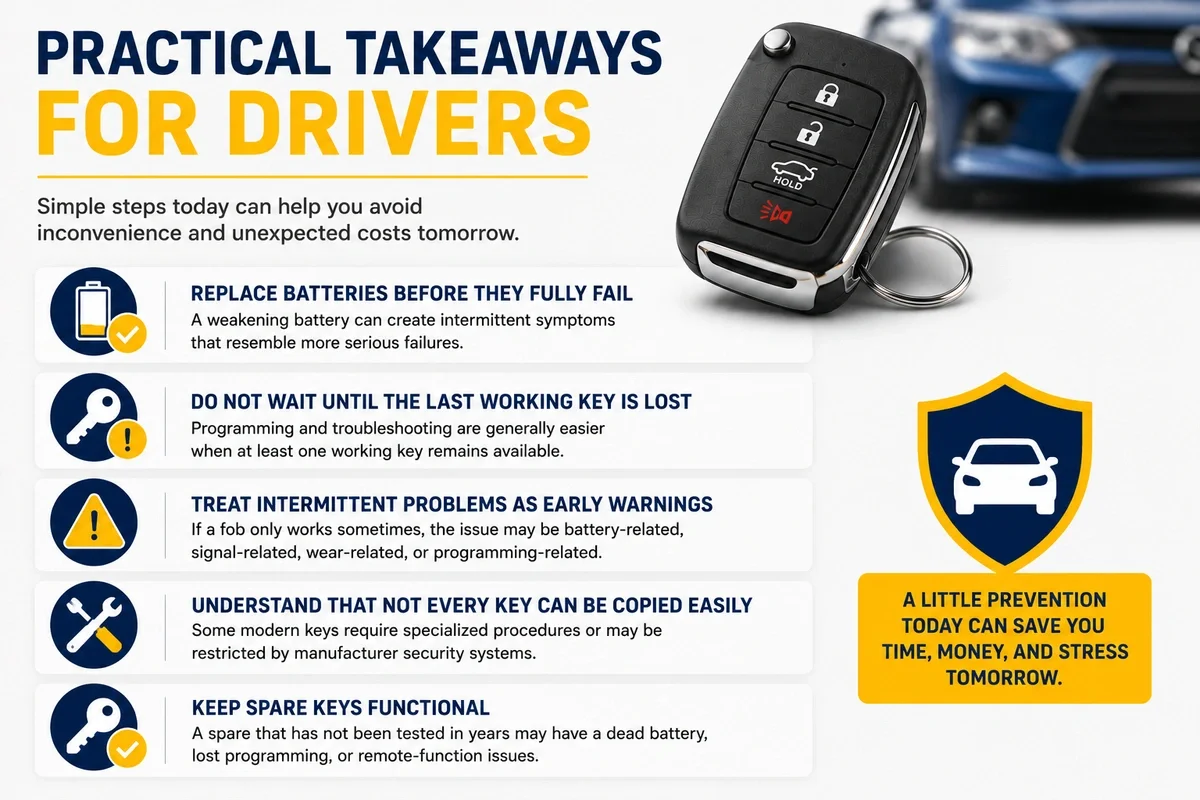
Replace Batteries Before They Fully Fail
A weakening battery can create intermittent symptoms that resemble more serious failures.
Do Not Wait Until the Last Working Key Is Lost
Programming and troubleshooting are generally easier when at least one working key remains available.
Treat Intermittent Problems as Early Warnings
If a fob only works sometimes, the issue may be battery-related, signal-related, wear-related, or programming-related.
Understand That Not Every Key Can Be Copied Easily
Some modern keys require specialized procedures or may be restricted by manufacturer security systems.
Keep Spare Keys Functional
A spare that has not been tested in years may have a dead battery, lost programming, or remote-function issues.
Frequently Asked Questions
What is the most common key-fob problem in KeyMe service data?
Programming-related issues represent the largest service category in the dataset, showing that many modern key-fob problems involve electronic authentication rather than visible hardware damage.
Why does my key fob work sometimes but not always?
Intermittent performance can come from a weak battery, signal interference, worn internal contacts, damaged electronics, or vehicle-side communication issues.
Why does my copied key unlock the door but not start the vehicle?
The key may be mechanically correct but not electronically authenticated. Many vehicles require a programmed transponder or smart credential before the engine will start.
Can every key fob be copied?
No. Some modern keys use advanced security systems that may require manufacturer-controlled procedures, secure gateway access, or specialized programming workflows.
Why do newer keys have more complicated problems?
Newer keys often combine mechanical cutting, remote functions, transponder authentication, proximity detection, and encrypted communication. A failure in any part of that system can affect performance.
What should drivers do before a key fob fails completely?
Replace weak batteries, test spare keys periodically, protect fobs from damage, and create a working spare before the last key is lost or stops functioning.
Methodology
This report is based on proprietary KeyMe automotive key service and troubleshooting data collected through vehicle key programming, duplication, replacement, and customer-support interactions nationwide. The analysis includes customer-reported issues, programming outcomes, compatibility reviews, refund classifications, ignition-recognition failures, lock and unlock communication problems, button-functionality concerns, and vehicle authentication challenges observed across a wide range of vehicle makes, models, and years.
For this analysis, KeyMe reviewed the most common automotive key-fob error categories and support outcomes to identify recurring patterns affecting modern vehicle access systems. Particular attention was given to programming failures, vehicle-recognition issues, remote-functionality concerns, and other indicators of how increasingly sophisticated security systems affect everyday drivers.
The findings were interpreted using the operational expertise of KeyMe’s automotive key specialists, locksmith network, vehicle programming technicians, and support teams. The resulting insights reflect real-world service activity across thousands of automotive key transactions rather than laboratory testing or manufacturer-reported performance data.
Because vehicle security architectures vary significantly by manufacturer and model year, individual duplication requirements and troubleshooting experiences may differ. The purpose of this report is to identify nationwide patterns in automotive key-fob performance and reveal how evolving vehicle security technology is reshaping the most common access challenges drivers face today.
About KeyMe Locksmiths
KeyMe Locksmiths is a leading provider of local locksmith services and key copy kiosks across 50 states and the District of Columbia. Proud to serve over 5 million customers, KeyMe Locksmiths cuts over 10 million keys annually. With more than 8,000 self-service kiosks in major retailers, an e-commerce platform delivering over 10,000 keys weekly, and a nationwide locksmith network, KeyMe Locksmiths provides fast, reliable solutions for residential, commercial, and vehicle needs. KeyMe Locksmiths is committed to delivering exceptional service backed by a 100% money-back guarantee. KeyMe Locksmiths also operates one of the nation’s leading retail media networks, connecting consumers to other brands seeking to advertise in-store and delivering over 2B monthly impressions.